
Terra Incognita (Unknown Land) - Part II
Curator Mohamed Benhadj
ENG
With Terra Incognita (Unknown Land) – Part II, Al-Tiba9 Gallery continues its exploration of transformation, perception and presence of materials through the works of Andy Storchenegger, Ching-ke Lin, Dal Molin & Milani, Dongbay, and Nicolas Vionnet.
Conceived as a second chapter, the exhibition extends the initial reflection on unknown territories and shifts the focus toward how these spaces are inhabited and reinterpreted.
The works presented develop a dialogue with unstable environments where forms appear altered and material surfaces suggest gradual transformation. Each practice engages with space as something evolving rather than fixed. The landscape becomes perceptual, shaped by subtle interventions and quiet displacements that invite a slower reading of the works.
In this continuation, Terra Incognita unfolds as an open territory where the unfamiliar becomes part of the viewing experience. The exhibition encourages a direct encounter with material and form, allowing meaning to emerge progressively as viewers move through the space.
ESP
Con Terra Incognita (Unknown Land) – Part II, Al-Tiba9 Gallery continúa su exploración de la transformación, la percepción y la presencia de los materiales a través de las obras de Andy Storchenegger, Ching-ke Lin, Dal Molin & Milani, Dongbay y Nicolas Vionnet.
Concebida como un segundo capítulo, la exposición amplía la reflexión inicial sobre territorios desconocidos y desplaza el foco hacia cómo estos espacios son habitados y reinterpretados.
Las obras presentadas desarrollan un diálogo con entornos inestables donde las formas aparecen alteradas y las superficies materiales sugieren una transformación gradual. Cada práctica se relaciona con el espacio como algo en evolución, más que como algo fijo. El paisaje se vuelve perceptivo, configurado por intervenciones sutiles y desplazamientos silenciosos que invitan a una lectura más pausada de las obras.
En esta continuación, Terra Incognita se despliega como un territorio abierto donde lo desconocido pasa a formar parte de la experiencia de observación. La exposición fomenta un encuentro directo con el material y la forma, permitiendo que el significado emerja progresivamente a medida que los visitantes recorren el espacio.
CAT
Amb Terra Incognita (Unknown Land) – Part II, Al-Tiba9 Gallery continua la seva exploració de la transformació, la percepció i la presència dels materials a través de les obres d’Andy Storchenegger, Ching-ke Lin, Dal Molin & Milani, Dongbay, i Nicolas Vionnet.
Concebuda com un segon capítol, l’exposició amplia la reflexió inicial sobre territoris desconeguts i desplaça el focus cap a com aquests espais són habitats i reinterpretats.
Les obres presentades desenvolupen un diàleg amb entorns inestables on les formes apareixen alterades i les superfícies materials suggereixen una transformació gradual. Cada pràctica es relaciona amb l’espai com quelcom en evolució, més que no pas fix. El paisatge esdevé perceptiu, configurat per intervencions subtils i desplaçaments silenciosos que conviden a una lectura més pausada de les obres.
En aquesta continuació, Terra Incognita es desplega com un territori obert on allò desconegut passa a formar part de l’experiència de visió. L’exposició afavoreix una trobada directa amb el material i la forma, permetent que el significat emergeixi progressivament a mesura que els visitants recorren l’espai.
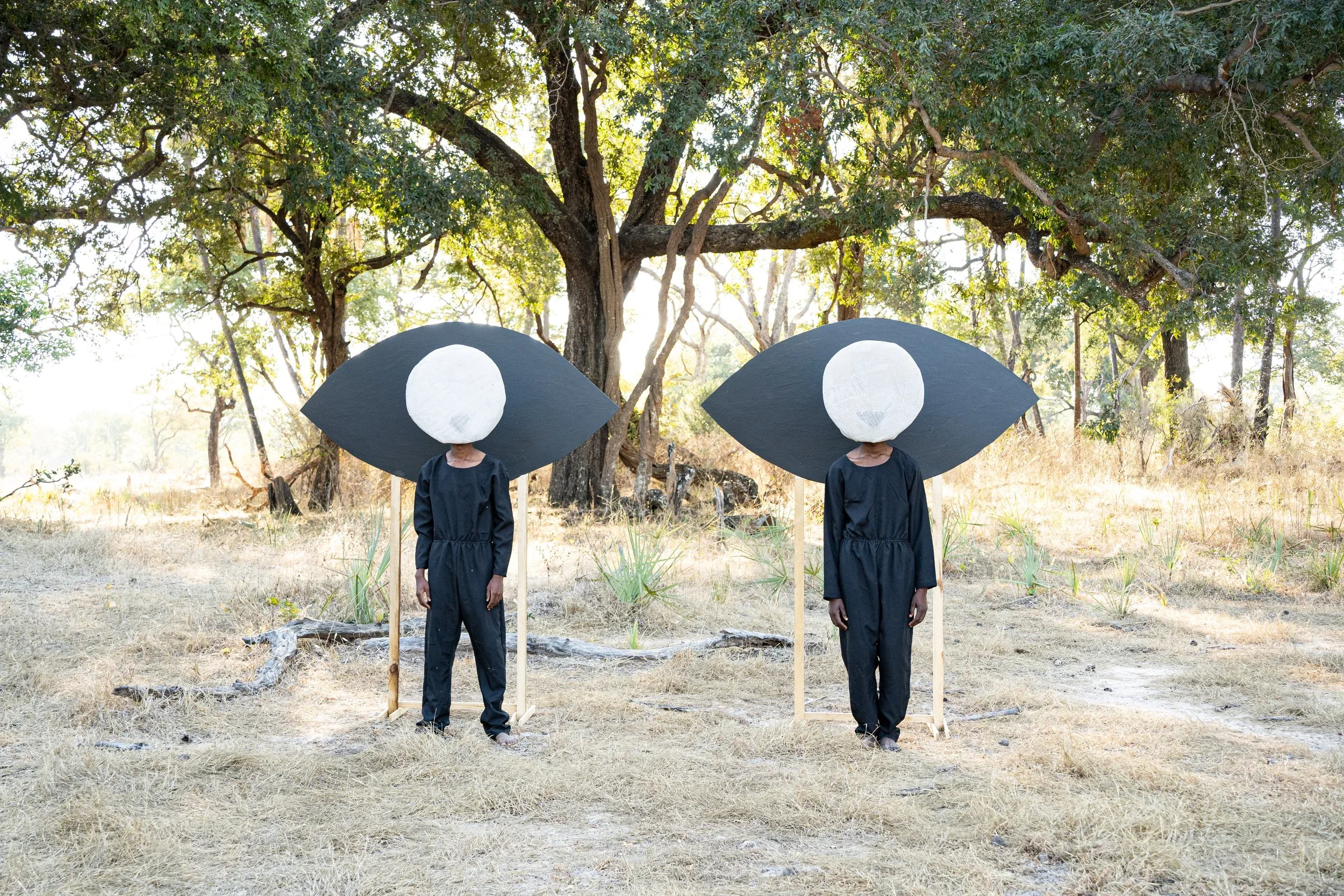
Andy Storchenegger Nobody is Okay, 2022
HD Video
Edition 1/3
This work, as multidisciplinary interactive art experience, is a collaboration between Andy Storchenegger, a Swiss visual artist and Zambian poet, Marita Banda. Nobody is Okay navigates the idea of not belonging through three chapters namely; Observer, Perception and Deviant.
The art of masquerade is a worldwide phenomenon; an age old one. Throughout human history, in every society, across demographics of race, gender, age, ethnicity, marital and economic status and others, humanity has had a need to camouflage. Psychologists attribute this behaviour or attitude to what they call, ‘The Myth of Inadequacy.’
This video work explores the concept of masquerade from an angle that exposes the idea that the uncomfortable is rife, expected and must be acknowledged. In a world where home has been heralded as a place where we can be free to be ourselves, we are faced with ghosts that haunt us with the notion that we actually do not have a place where we truly belong. Humans are plagued with the constant state of longing. In moments of honest contemplation in solitude, the restlessness shows up. We often crave the company of others or chasing after some adventure or other in an effort to numb or escape that feeling. We invent distractions all the time. We often innovate fantastic ideas of boundaries at every opportunity simply to avoid the awkwardness of not belonging.
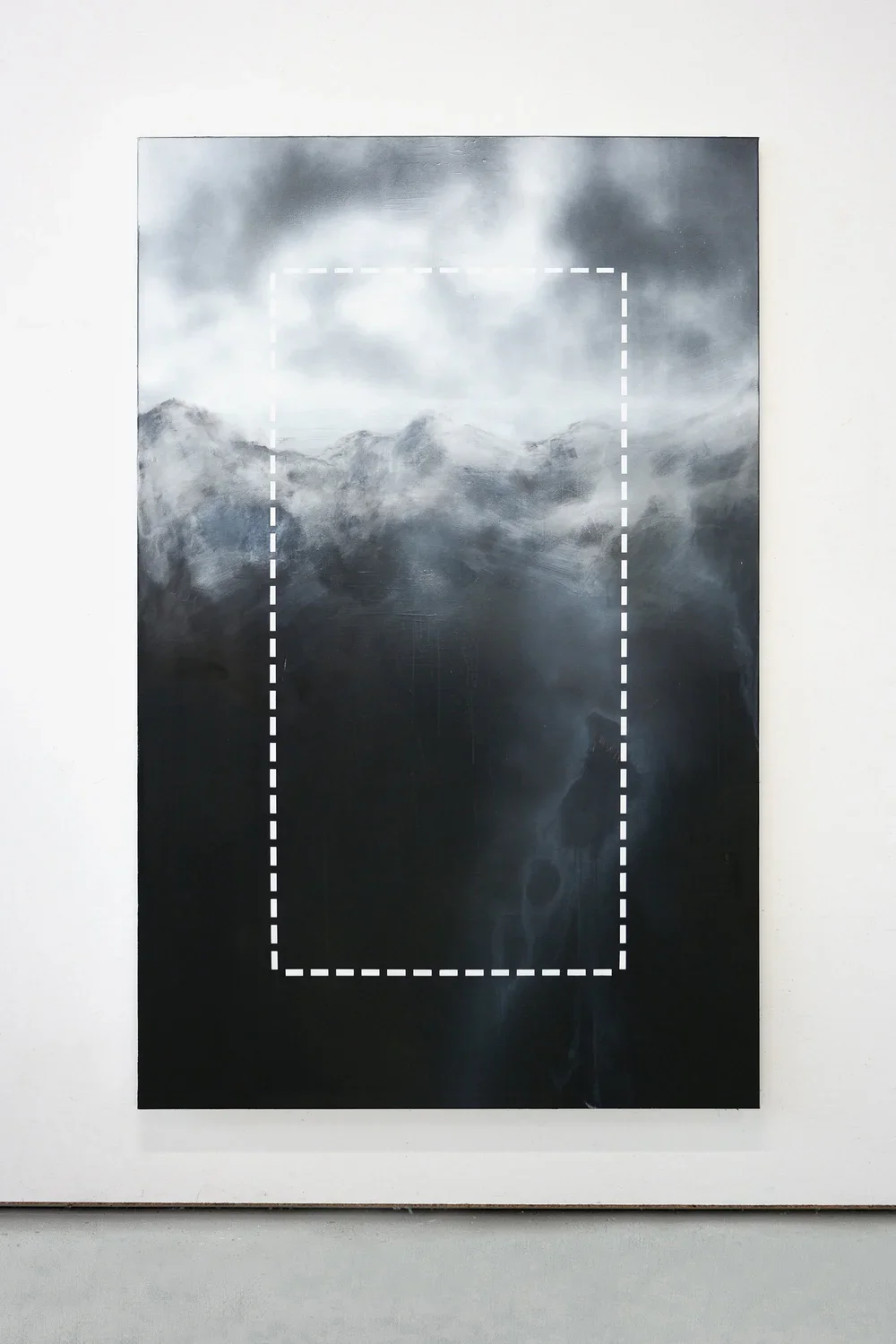
Nicolas Vionnet – Deathly Silence, 2016
Mixed Media on canvas | 220 x 140 cm
The work “Deathly Silence” by Nicolas Vionnet is a landscape painting that at first glance shows an idyllic mountain landscape after an avalanche. The soft gray tones of the oil painting convey a calm, peaceful atmosphere in which nature seems to have come to rest. Nothing hints at the destructive force that previously raged here. However, this apparent idyll is disturbed by a centered, graphically dashed rectangle that acts like a visual cut through the harmonious composition. This element brings an unexpected tension to the picture and challenges the viewer to reflect on the discrepancy between outer calm and inner unrest. Through this contrast, Vionnet succeeds in hauntingly thematizing the fragility of nature and the latent threat that lies hidden in its beauty.
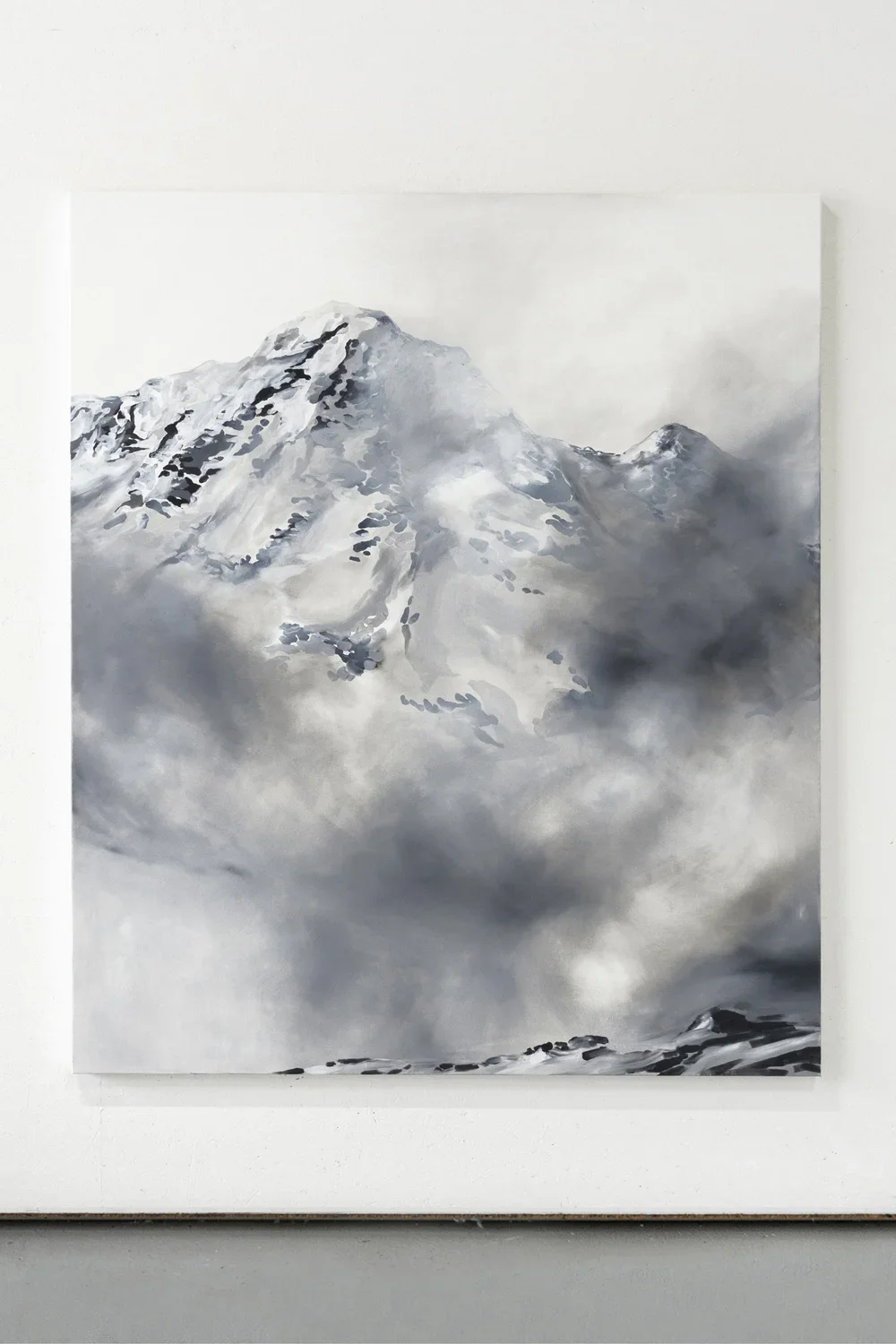
Nicolas Vionnet – Deathly Silence, 2017
Oil on canvas. | 200 x 170 cm
The work “Deathly Silence” by Nicolas Vionnet is a landscape painting that at first glance shows an idyllic mountain landscape after an avalanche. The soft gray tones of the oil painting convey a calm, peaceful atmosphere in which nature seems to have come to rest. Nothing hints at the destructive force that previously raged here. However, this apparent idyll is disturbed by a centered, graphically dashed rectangle that acts like a visual cut through the harmonious composition. This element brings an unexpected tension to the picture and challenges the viewer to reflect on the discrepancy between outer calm and inner unrest. Through this contrast, Vionnet succeeds in hauntingly thematizing the fragility of nature and the latent threat that lies hidden in its beauty.
ARTWORKS
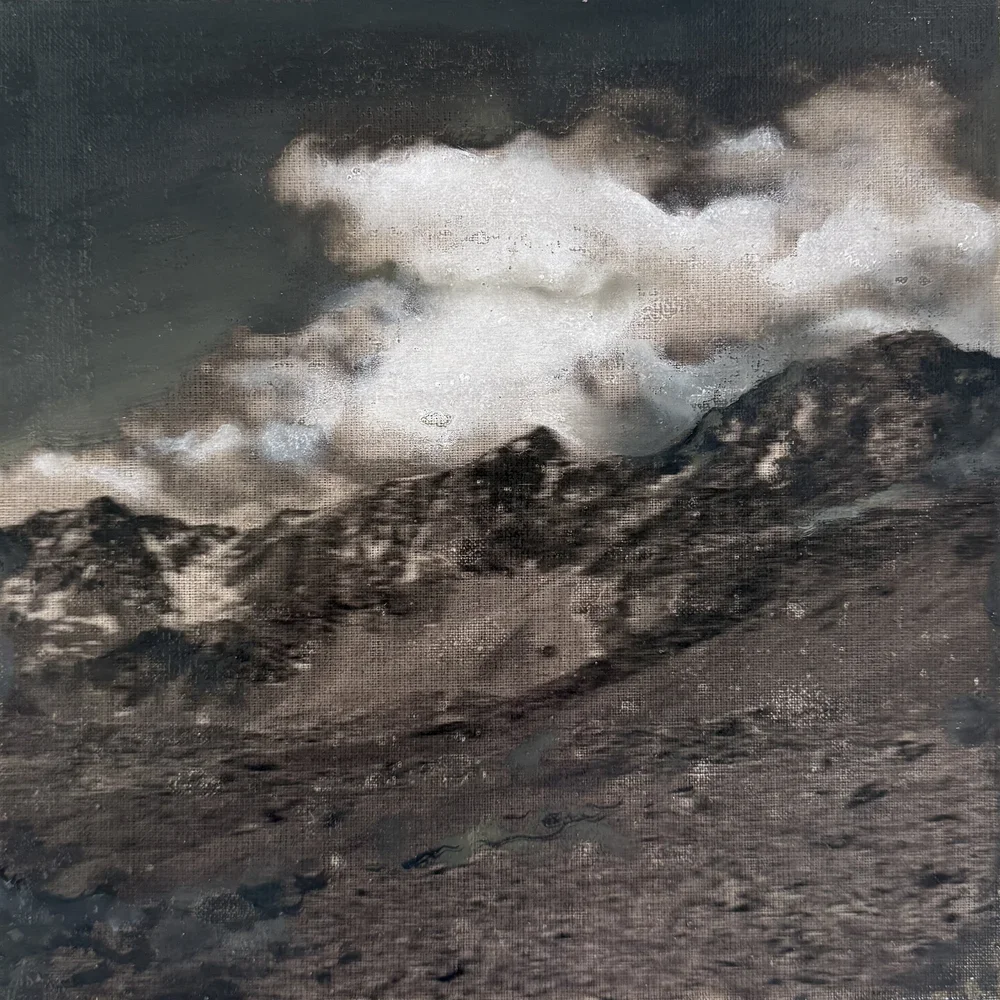
Nicolas Vionnet – Landesvermessung, 2016-2026
Oil and photo transfer on unprimed canvas | 30 x 30 cm
The Swiss national coordinate system, abbreviated CH1903 or LV03 for “Landesvermessung 1903,” is a fundamental geodetic framework. It plays a central role in official surveying and in the creation of numerous maps of Switzerland. Its precise coordinates allow for the exact localization of geographic information and are therefore indispensable for infrastructure planning and scientific research.
Against this historical backdrop, Nicolas Vionnet created his series Landesvermessung, in which he captures various landscape constellations in painterly form. The titles of the individual works consist of exact geographic coordinates (for example, 47.309248/8.779071), indicating the location where the source photograph was taken. This fusion of art and science creates an interface where the objective reality of surveying meets the artist’s subjective interpretation. Vionnet’s works invite viewers to reflect on the meaning of place and identity.
At a time when digital technologies are ubiquitous, the artist reminds us that behind every coordinate lies a story and a cultural heritage. His work is a critical engagement with the notion of land surveying and the spatial control inherent in it. By designating these coordinates, often with a hint of irony, as the titles of his works, Vionnet prompts us to reconsider our own relationship to the landscape and the experiences bound up with it.
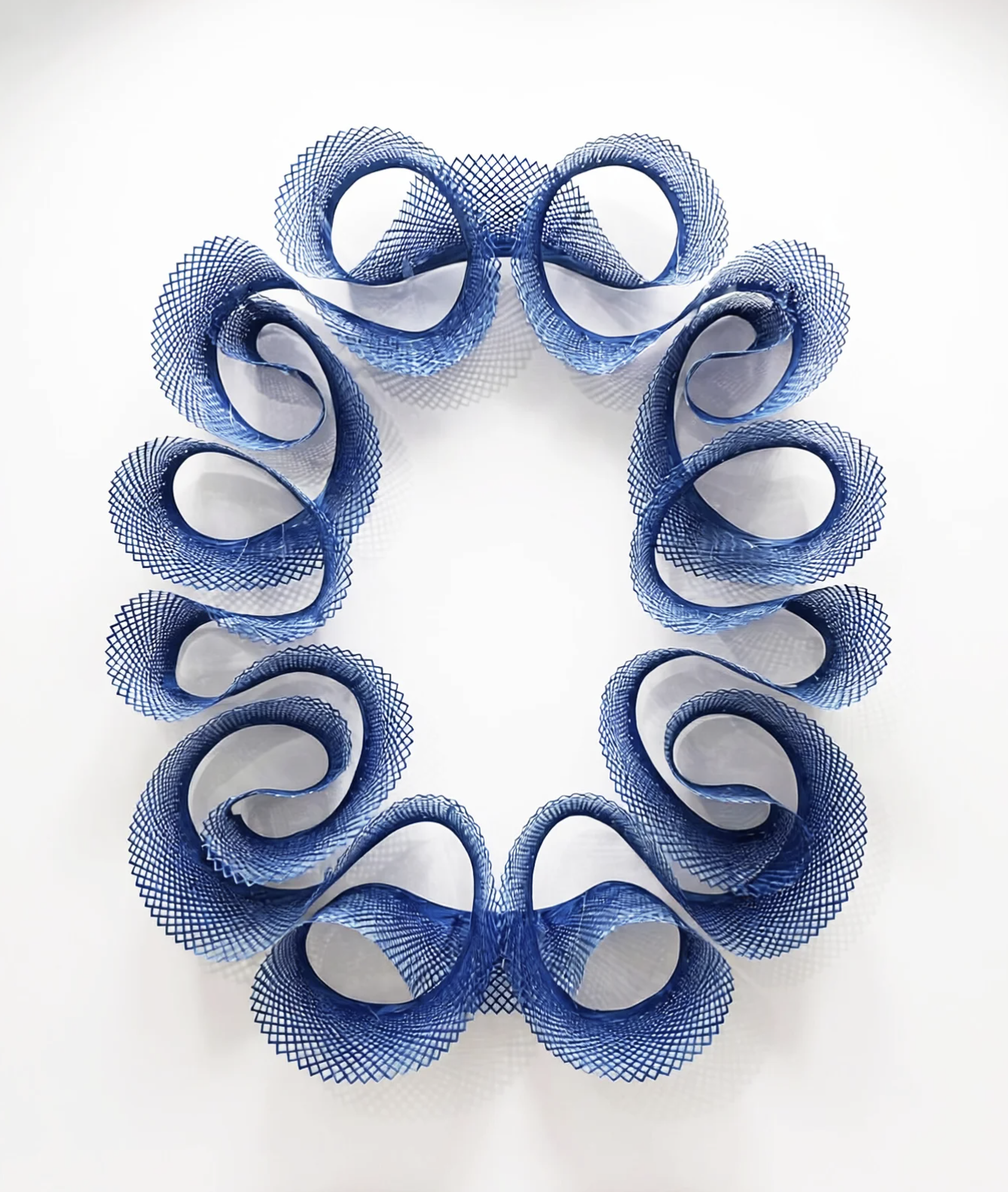
ChingKe Lin – Floating Court Reflections, 2026
Bamboo | 190 × 170 × 50 cm
Set in motion by the act of winding, lines unfold slowly along an oval threshold. Through spiraling, layering, gathering, and dispersing, they form a shifting rhythm—at once wave-like, shadow-like, and quietly expansive. The form appears to rise gently from the wall and linger within space, allowing the boundary to become not a limit, but a site of perception.
The suppleness of bamboo sustains the extension of each line, while its intricate textures retain an inner pulse within stillness. Subtle undulations are gathered into a quiet, finely articulated whole, inviting the viewer into a gradual process of emergence. As the gaze moves back and forth, textures seem to form and converge, allowing shape and pattern, through their mutual reflection, to softly unfold a silent rhythm.
Nicolas Vionnet, Rock’n’Roll, Part II, 2020
Skateboard, forearm crutches with leather cuff
124 x 78 x 19 cm
Nicolas Vionnet's sculptures and installations are perplexing and uncanny. His practice lies at the intersection between irritation and integration. His works are subtle, often ironic, and inspire curiosity through their seamless integration with the landscape or readymade object of his choosing.
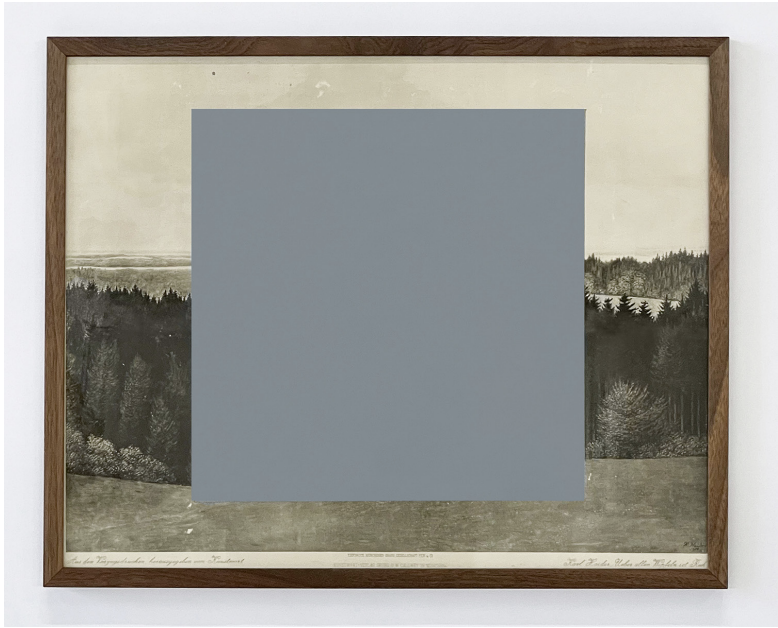
Nicolas Vionnet, Über allen Wipfeln ist Ruh #1, 2015
Iron mica paint on art print (artist: Karl Haider), framed
40 × 50 cm
Karl Michael Haider (1846–1912, Munich) was a German landscape and portrait painter. He received his first artistic training from his father, a forestry officer, who taught him—during long excursions through the forest—careful observation and precise, detailed representation.
Nicolas Vionnet makes a provocative intervention on a print of Haider’s work: he overpaints the image with micaceous iron oxide paint, deliberately leaving the motif visible along the edges. This type of paint is a highly weather-resistant, durable anti-corrosion coating primarily used in industrial contexts. Through this gesture, Vionnet appears, at first glance, to destroy the original work—yet in fact, his act preserves the underlying layers for posterity.
The title of the original work, “Über allen Wipfeln ist Ruh” (“Above all treetops there is peace”), is consciously retained by Vionnet—an ironic nod to the newly constructed image.
Dongbay, Scarecrow, 2024
Recycled CarharttWIP Products & Mixed Media
380 × 200 × 60 cm
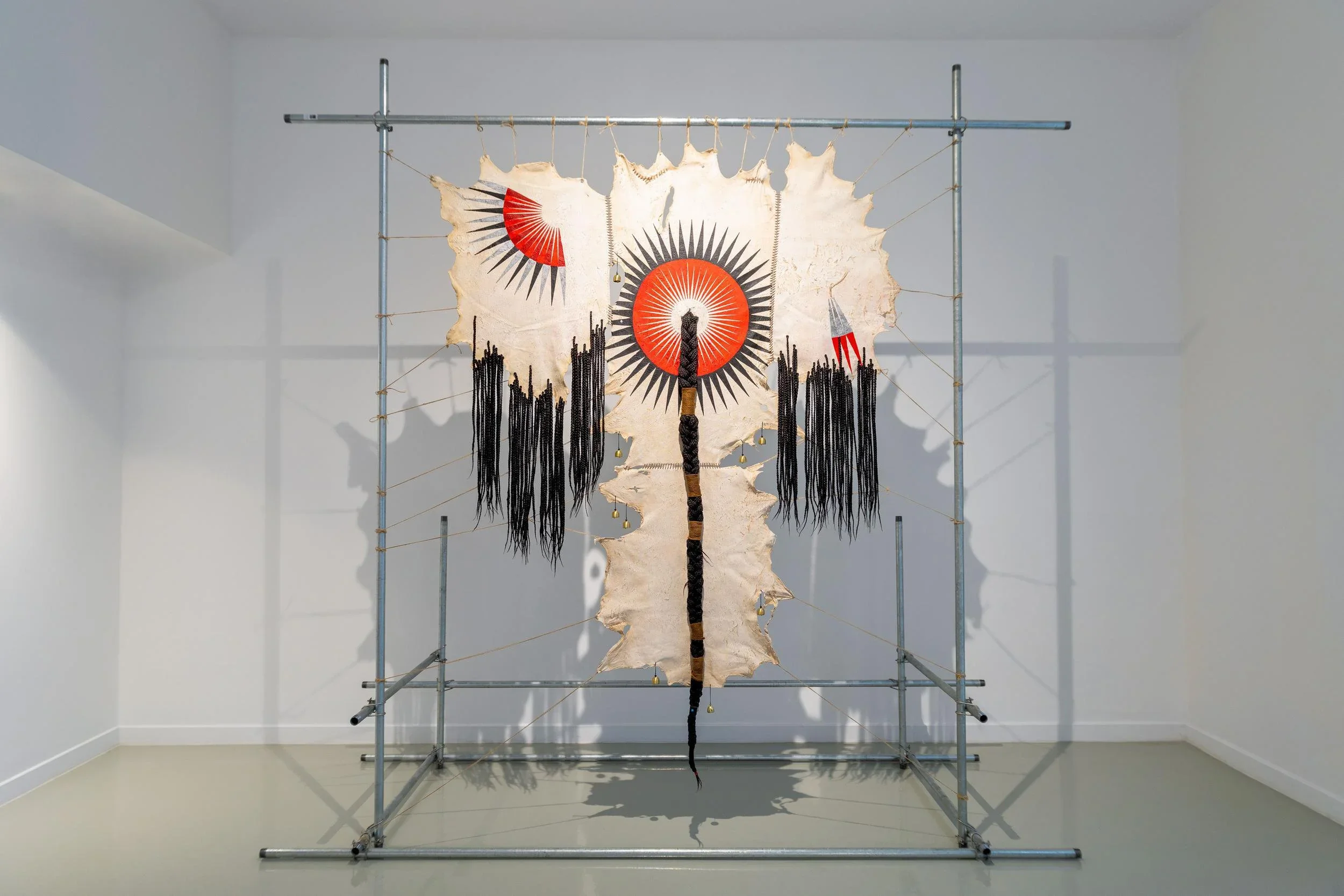
“Scarecrow” is an exploration of industrial excess and anti- commodification. It dissects mass-produced goods, deconstructing and reassembling them into new symbolic structures. Operating within a framework of symbiosis, the installation reflects the tension between uniformity and individuality, order and decay. Drawing from synthetic totems, it critiques the overproduction of commodities while questioning their cultural and spiritual significance in a hyper-industrialized world.
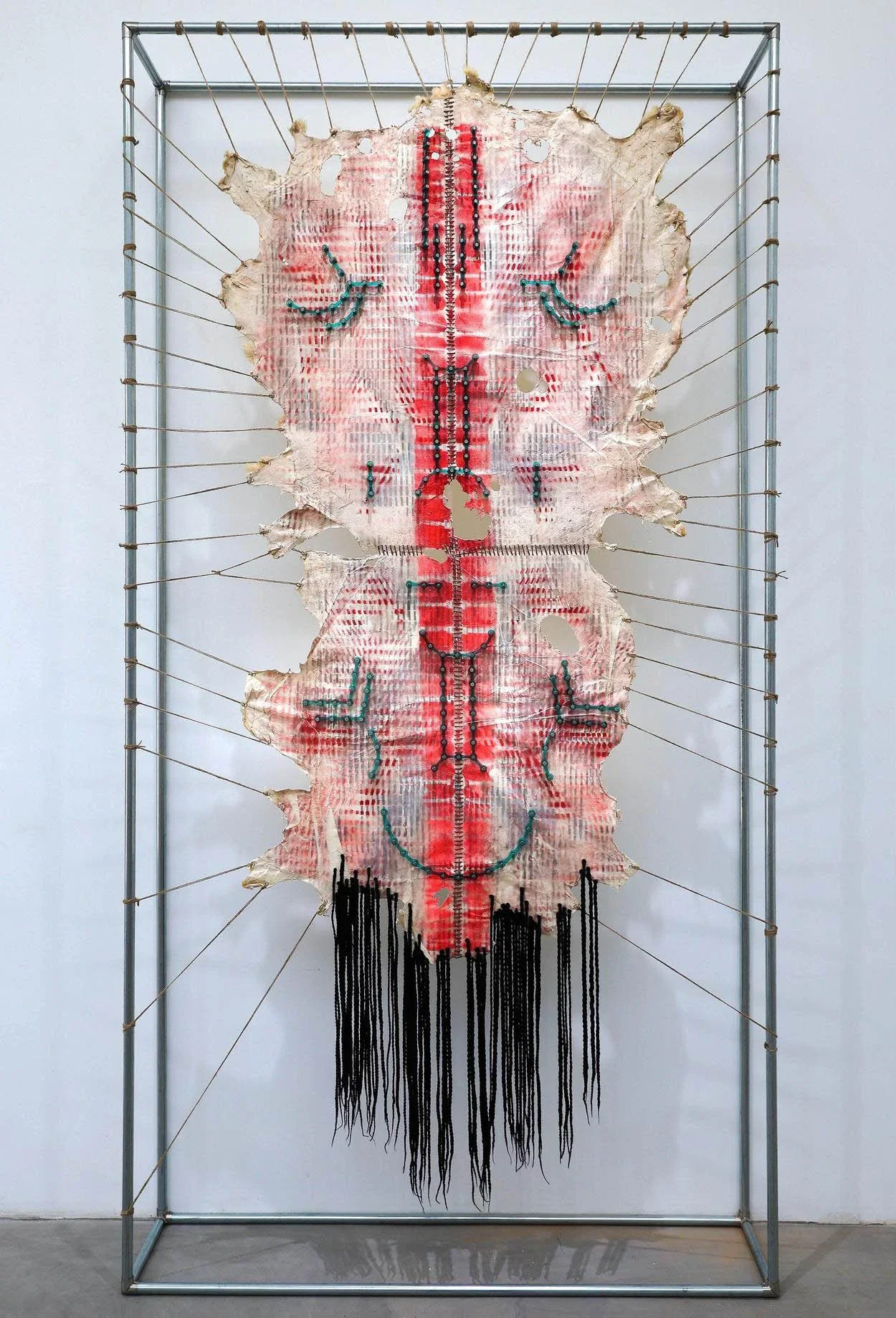
Dongbay, Hybrid Cluster, 2025
Recycled Animal Material & Mixed Media
300 × 150 × 30 cm
The body today is both a ritual vessel and a technological construct. “Hybrid Cluster” probes identity’s fluidity and space’s redefinition, questioning selfhood at the organic-artificial nexus. In a control-driven society, is the human spirit constrained? Does spontaneity endure? This tension reflects modern anxiety: yearning for nature and stability against inevitable flux and civilized dependence. The work examines the body’s place in its environment, inviting reflection on power, agency, and the flow defining existence.
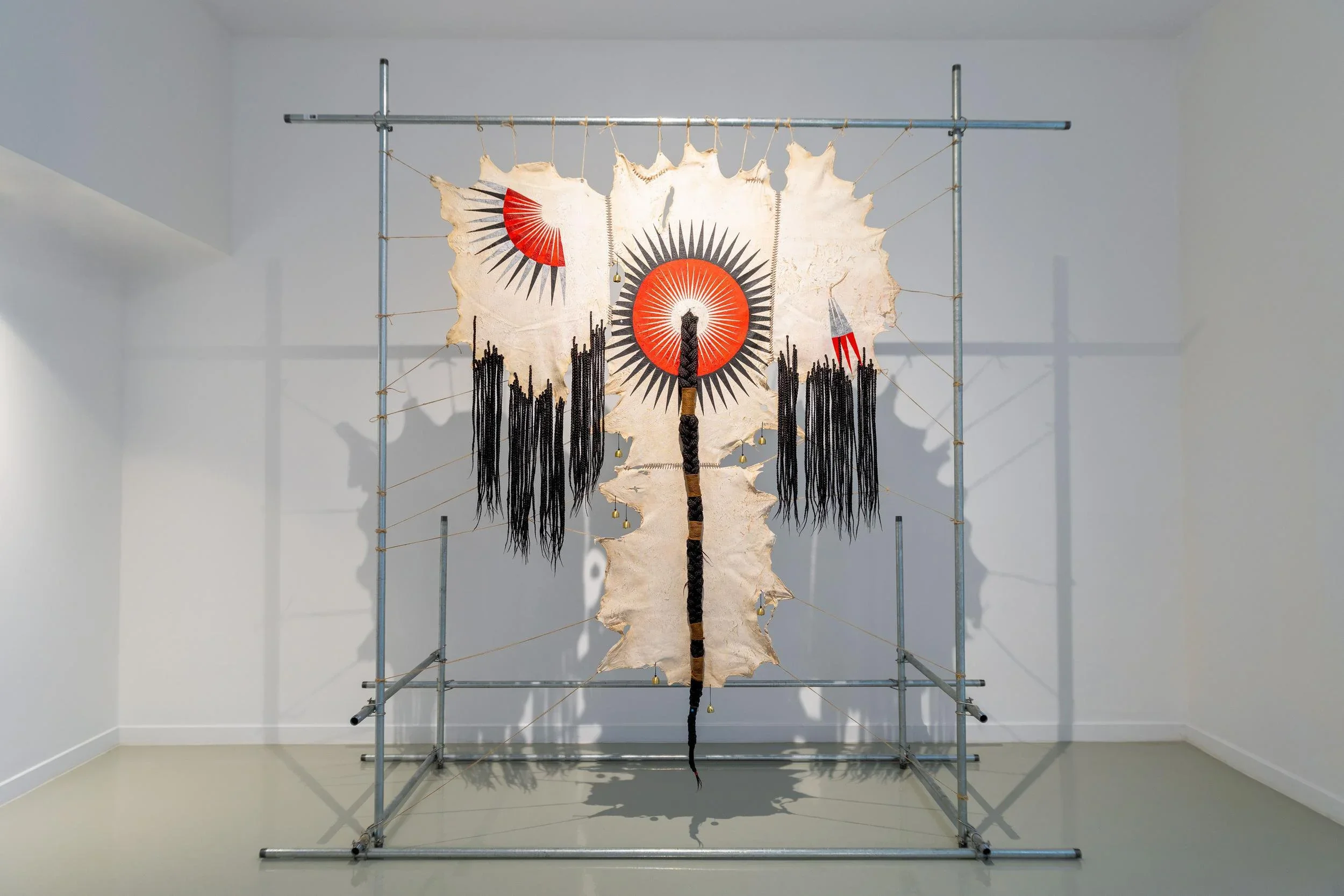
Dongbay, Quene Locks, 2023
Recycled Animal Material & Mixed Media
250 × 200 × 100 cm
“Quene Locks” is hand-made from materials such as animal skin/hair and steel pipes. Animal skin is the container of body and soul, and hair is memory and the carrier of soul. Faced with the incomplete container itself, Dongbay locked the barbarians Quene culture inside it, completing a new reincarnation. The skeleton of the new body is made of industrial materials such as steel pipes, forming a synthetic body in the post-industrial era. The work sways with the flow of air, and at the same time emits crisp wind chimes, combing it with the sounds of the environment in the current moment.
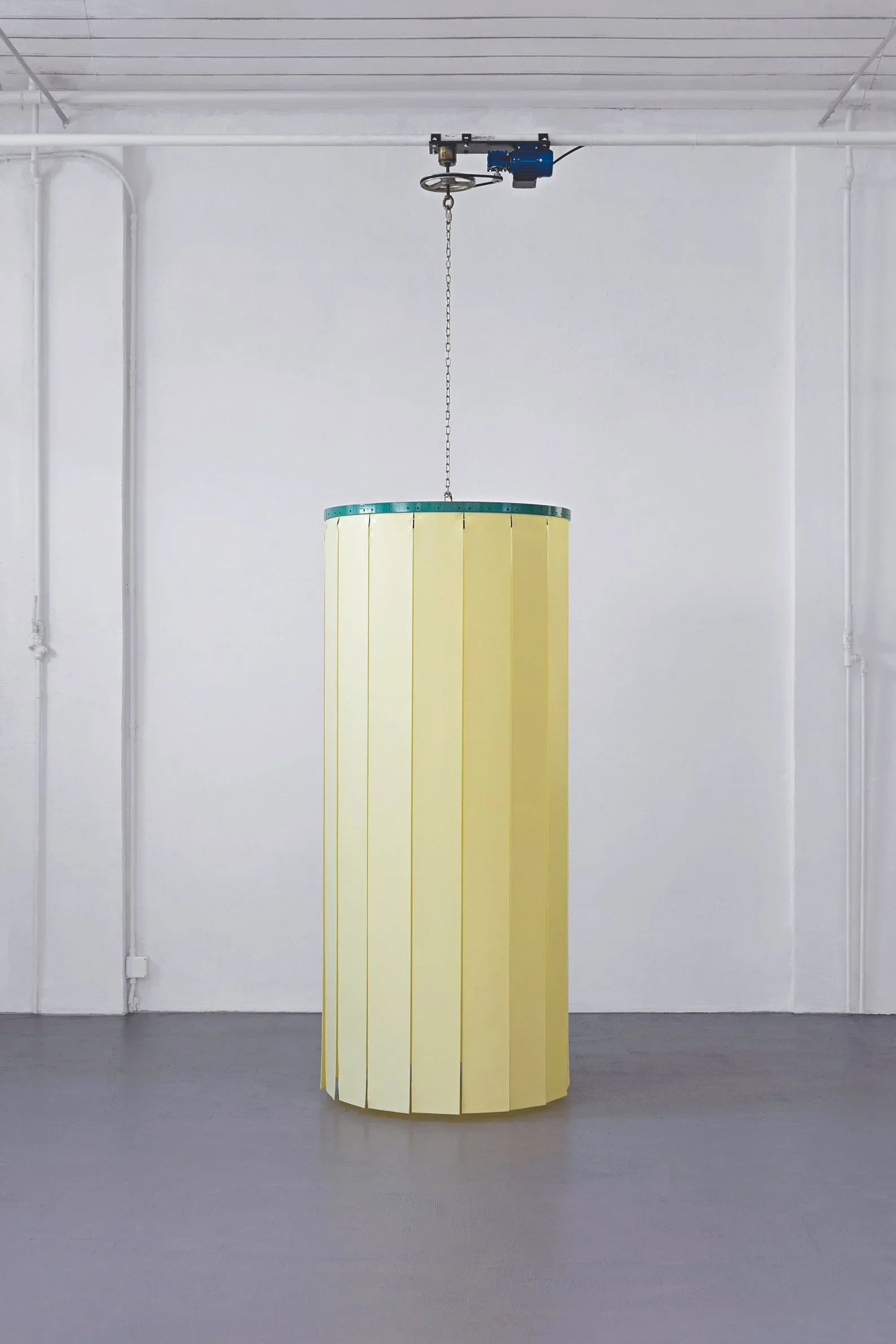
Dal Molin & Milani, Muletto, 2022
Silicone rubber, powder-coated iron, motor
Diameter 100 cm, height 240 cm
A rotating, traversable structure invites the audience to engage with space and
explore their bodily perception. The silicone rubber curtains are inspired by the PVC strip
curtains commonly used to divide industrial environments, suggesting an inextricable link
between work and play, and between spaces of production and those of entertainment.
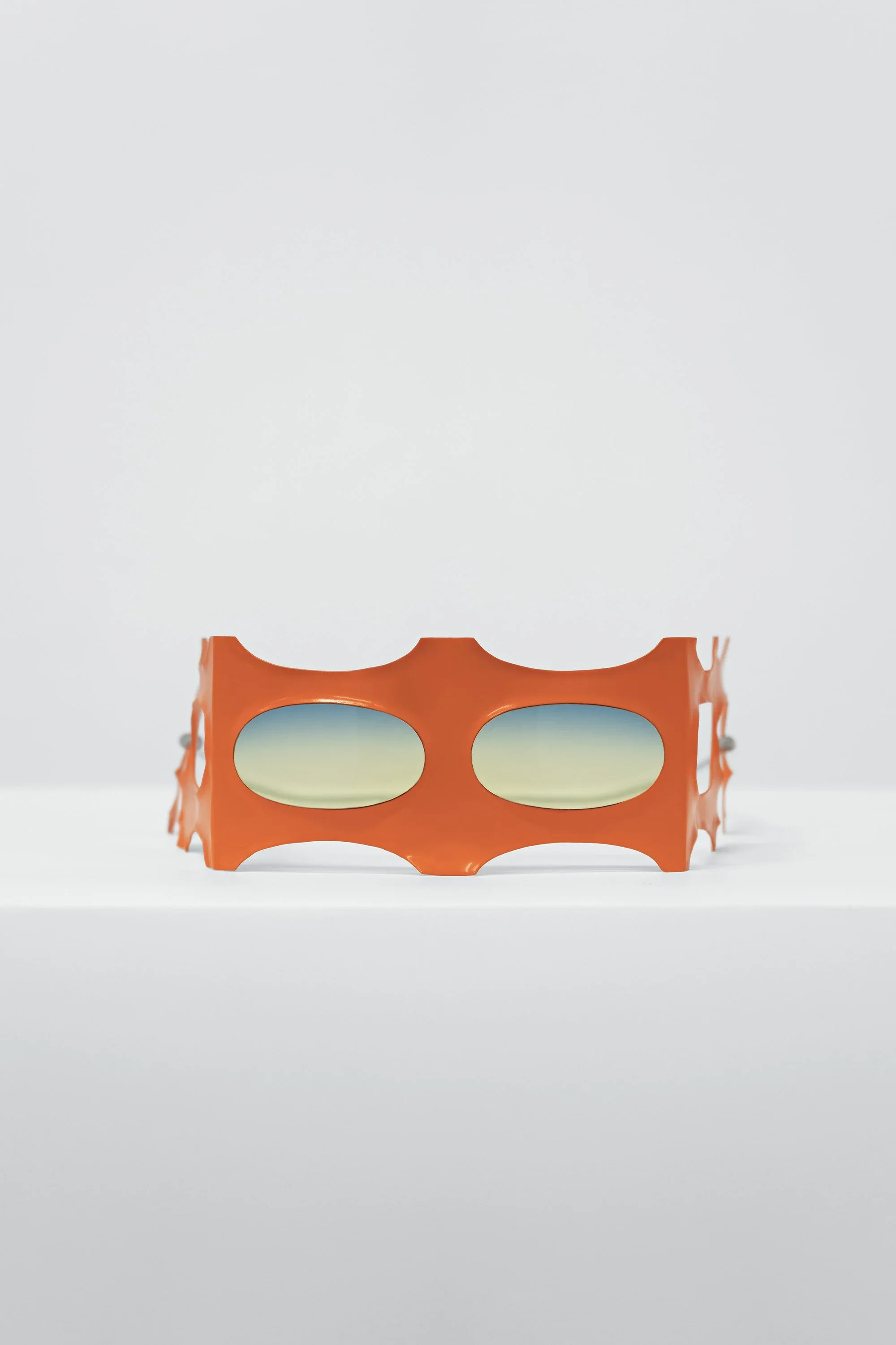
Dal Molin & Milani, Paesaggio veloce, 2024
Painted aluminium, lens, steel cable
15 x 30 x 7 cm
The orange net of construction sites is a constant element in the contemporary landscape and emblematic of its change. Exploiting the iconic form of these nets generates the frame of a sports eyeglass that, with its shaded lenses, looks to a possible future panorama.